

When the Texas Hold ‘em poker game starts, you get two hole cards as your starting hand, and the key is to recognize the strength of the hand and whether it has any playing potential. So, the question is to play the starting hand or not. Still, there are other factors to consider, and here is where poker ranges come into play. In poker, a range is the combination of starting hands the poker player may have at any moment. Combining your knowledge about poker ranges and starting hands will help you become better at poker, so our experts here outline which are the best Texas Hold ‘em starting hands and how to utilize these and poker ranges to your advantage.
Quick Jump ⇣
Top Texas Hold ‘em Starting Poker Hands
Because Texas Hold ‘em poker is played with a standard 52-card deck, and the poker starting hand has two cards, it means there are 1326 possible combinations or 169 non-equivalent hand combinations. We present these at a single 13×13 table where you can see that there are 13 pocket pairs, 78 suited and 78 off-suit hands.
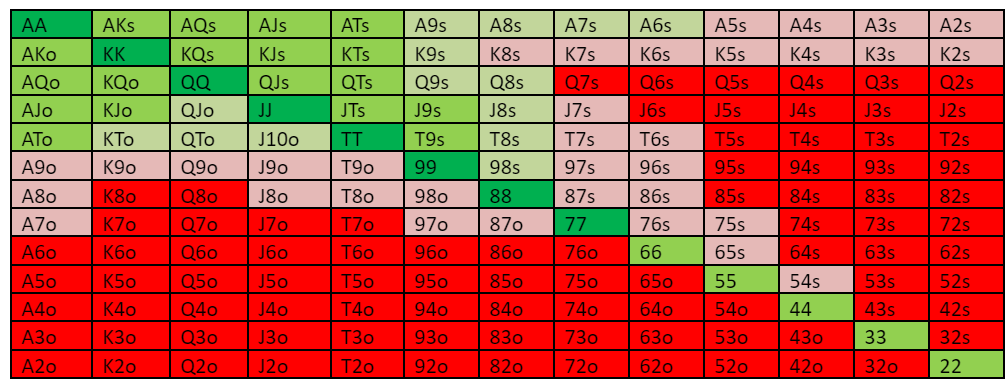
The diagonal (highlighted in green) shows the pocket pairs that are among the best starting hands you can have. The upper values (AA to 77), highlighted in dark green, have better playability. In contrast, the lower values (66 and lower), highlighted in light green, have a playing chance only when you play in a late position at the poker table.
Now, for the rest of the table, initially, it may not look obvious, but it is actually effortless to read when you know what each color means, which we show you here:

From the table and color coding, you can see that you have the best chance to play a good game of Texas Hold ‘em poker when you have a pocket pair or a pair of high cards or connected cards. The light red color means that you can play with that Texas Hold ‘em starting hand only if you play in a late position, and the bright red color means it is an unplayable hand and you should fold immediately.

Credit: 20Bet
Try your luck and poker knowledge by joining 20Bet!
Claim your Welcome Bonus Now!Poker Starting Hands & Position Relation
Above, we touched a little about the poker starting hands and how these relate to your playing position in Texas Hold ‘em poker. Apart from knowing the rules in poker, you need to know the playing potential of each position. The position where you sit at the poker table in relation to the dealer is important, as you need to adopt different playing strategies when you play at various positions. Here are the positions in Texas Hold ‘em poker and how these relate to the starting hands:
- Blinds: the small and big blinds are the first two positions on the left of the dealer that place the mandatory bets; you should play with high cards and high pocket pairs when playing in this position
- UTG (Under the Gun): the next position after the blinds that opens the betting round; you should play with high cards and all pocket pairs when playing in this position
- Middle positions: the positions in the middle of the table that make their action after the UTG position opens the betting round; you can play with all pocket pairs, high cards, and high connector cards when playing in this position
- Late position: the last player to make an action before the dealer deals the following street; you can play with a broader range of starting hands when playing in late position
Relate Starting Hands and Poker Ranges
As you can see from the table above, knowing the poker ranges is a valuable skill in poker, as these allow you to make quick estimates on your starting hand, as well as assign a starting range to your opponents, and you can use these to read the poker hands. You can later use your knowledge of poker ranges and your analysis of the playing style of your opponents to narrow down their possible hands and gain an edge. Knowing how to correctly utilize these can even help you become better at bluffing, which you can also learn with our guide with bluffing tips.
Pre-Flop Hand Ranges
Several pre-flop hand ranges are worth playing, as these can be used in many combinations, and you can gain a significant edge over the other poker players. Here are the top-rated starting hands you should never fold in Texas Hold ‘em poker:
- Pocket Aces (A♠ A♥): The best starting hand in Texas Hold ’em, it is the hand with the best winning odds
- Pocket Kings (K♠ K♣): The second-best starting hand in Texas Hold ‘em poker, a pair of kings usually works very well with the community cards
- Pocket Queens (Q♥ Q♦): The third-best starting hand in Texas Hold ‘em poker, it has excellent winning potential and does well in the flop
- Pocket Jacks (J♦, J♣): The pocket jacks are a good starting hand in Texas Hold ‘em, and it has a good potential to combine with the flop
- Pocket Tens (T♣, T♠): The pocket tens are a premium starting hand that you can easily use to your advantage
- Pocket Nines (9♥9♠): The pocket nines are a strong starting hand in Texas Hold ‘em, and you can use these in different combinations
- Pocket Eights (8♠8♥): This is a good starting hand in poker, as it has a good winning potential with a full house
- AK suited (A♥K♥): a non-pair known as the big slick, it is a starting hand with good potential
- AK Off-suit (A♣K♦): This is a strong hand that has up to a 50% winning chance against lesser hands
- AQ Suited (A♠Q♠): a premium hand with good playability, it has the potential to hit strong pairs
- AJ Suited (A♦J♦): This is another premium hand with good playability, with excellent flush and straight potential
- KQ Suited (K♣Q♣): An excellent starting hand in Texas Hold ‘em poker, this hand can hit high pairs, flushes, and straights.
- AT Suited (A♦T♦): A good starting hand, it has an excellent playing potential where you can use it for a strong pair, flush, and straight

Credit: Wazamba
Join Wazamba and play Texas Hold ‘em and other poker varieties!
Claim your Welcome Bonus Now!FAQs
What are good starting hands in Texas Hold ’em?
There are several poker starting hands that are considered premium in Texas Hold ‘em poker, and these are high pocket pair, high-suited pairs, and high connector cards: AA, KK, QQ, JJ, TT, 99, 88, AKs, AQs, AKo, AJs, KQs, ATs, AQo, KJs, KTs, QJs, AJo, KQo, QTs. Please note that s stands for suited, and o is for off-suit cards.
Which hands should I fold in poker instantly?
You should instantly fold starting hands that have no playing potential: Q7s, Q6s, Q5s, Q4s, Q3s, Q2s, J6s, J5s, J4s, J3s, J2s, T5s, T4s, T3s, T2s, 95s, 94s, 93s, 92s, 85s, 84s, 83s, 82s, 74s, 73s, 72s, 64s 63s, 62s, 53s, 52s, 43s, 42s, 32s, A6o, A5o, A4o, A3o, A2o, K8o, K7o, K6o, K5o, K4o, K3o, K2o, Q8o, Q7o, Q6o, Q5o, Q4o, Q3o, Q2o, J7o, J6o, J5o, J4o, J4o, J3o, J2o, T7o, T6o, T5o, T4o, T3o, T2o, 96o, 95o, 94o, 93o, 92o, 86o, 85o, 84o, 83o 82o, 76o, 75o, 74o, 73o, 72o, 65o, 64o, 63o, 62o, 54o, 53o, 52o, 43o, 42o, 32o. Please note that s stands for suited, and o for off-suit cards.
How many different starting hands are there in poker?
There are a total of 1326 possible starting hands in poker or 169 non-equivalent starting hands. Of these, 13 are pocket pairs, 78 are suited, and 78 are off-suit starting hands.
What hands should I play in poker pre-flop?
You should play the high pocket pairs, the high-suited pairs, and the high connector pairs. Depending on the position you play at the poker table, other starting hands may have good playing potential. If you play at the blinds position, UTG, or a middle position, you should only play the following starting hands: AA, KK, QQ, JJ, TT, 99, 88, AKs, AQs, AKo, AJs, KQs, ATs, AQo, KJs, KTs, QJs, AJo, KQo, QTs. But if you play at a late position, you can also have a good chance with these starting hands: 77, 66, 55, 44, 33, 22, A9s, A8s, A7s, A6s, K9s, Q9s, Q8s, J10s, J9s, J8s, T9s, T8s, 98s, 97s, 96s, 87s, 86s, 76s, 75s, 65s, 54s, ATo, A9o, A8o, A7o, KTo, K9o, QJo, QTo, Q9o, JTo, J9o, J8o, T9o, T8o, 98o, 97o, 87o.
What is a range in poker?
A range in poker is a collection of possible hands your opponents may hold. It is almost impossible to know what exact cards your opponent has when playing Texas Hold ‘em, so you assign poker ranges and observe their playing style to make an educated guess on the possible hand your opponent has.
What does pre-flop mean in Texas Hold ‘em poker?
Pre-flop is the play before the flop is dealt, and it includes placing the blinds and the opening bet. The first two players next to the dealer put the small and big blind as incentives to raise the pot, and the betting round continues with all the players making a suitable action, like check, bet, raise, or fold. The pre-flop ends with the dealer dealing the flop or placing the three community cards face-up on the table.
Can I go all in before the flop?
You can go all-in before the flop, and it is something you can do when you are short-stacked (they have a low chips count) and don’t have enough money to make any other action. In such a situation, you can go all in and hope to double your money, or you can fold pre-flop and leave the game.
When should I call in poker?
Calling in poker means to match the amount that the previous player has bet. But knowing when to call is ultimately linked to the position you play and your starting hand. If you play in an early position and have a low-value starting hand, it may be wiser to fold or even check, but you can call if you play in a late position and have a high pair, a pocket pair, or a pair of high connector cards.
Should I always raise pre-flop?
Raising pre-flop is a good poker strategy, as it places you in the role of an aggressive player who knows how to play poker and has a good starting hand. If you only match the big blind, it is a move known as limping, and it usually shows you are uncertain about your poker hand, and others may use it to their advantage.












 ️
️