

Also known as “Big Red”, Secretariat is most probably one of the most famous horses that ever lived and raced. The big stallion was born at the end of March 1970 and consecrated itself in the hall of fame only three years later by winning the Triple Crown of 1973. It became as successful as any athlete in the world of sports and ran his way into honors and statues.
Quick Jump ⇣
What Should We Know About Secretariat?
There are many interesting facts about the famous horse Secretariat that go beyond its titles and prizes. In fact, many curiosities concerning the unassailable winner are not known by the majority of the population.
🐎 How Tall Was Secretariat?
Secretariat was strongly built and had a naturally athletic body with a large chest and robust hindquarters, totaling 54 feet in height. Its weight was as close to perfectly possible as nature can produce, with well-distributed 1,175 pounds. To maintain that balance and a large stride, thanks to its muscle power, it ate 15 quarts of oats every day.
❤️ Secretariat’s Heart: Two and a Half Times Larger Than an Average Horse
The heart of an animal is the center of the circulatory system and is responsible for pumping blood throughout the body. The bigger a functional heart is, the better it can pump oxygen and nutrients, and that was an advantage Secretariat had.
Through necropsy after its euthanasia, the veterinarian Thomas Sweczek realized that the powerful stallion had a heart of 22 pounds, 2.5 times bigger than the average horse heart of 8.5 pounds. Even more impressive was the fact that it did not carry any negative anomaly or malfunction, and that had a great impact on its performance.
🏇 Who Was Secretariat’s Jockey?
Paul Feliciano, who had 653 firsts in his career, rode Secretariat in the first two races of his racing career. Then, Ron Turcotte replaced him and remained Secretariat’s jockey in all its other races.
He rode the horse to fame and even had a movie made on his story, “Secretariat’s Jockey”, with 7.6 IMDb. Unfortunately, a racing accident in 1978 left Turcotte paralyzed of both legs.
🤵♂️ Who Was Secretariat’s Owner?
Even though men dominated the industry of horse races, a woman named Penny Chenery was responsible for the legendary horse Secretariat and its legit owner. She decided to breed horses after her father became ill, ignoring the advice of her siblings. Secretariat was born from the union of the mare Somethingroyal with the stud Bold Ruler.
Chenery most probably played a major role in the career of Secretariat for trusting its talent to be a natural racehorse. Her faith proved to be a fact, and the rest of the story we tell you down below.
💵 How Much Did Secretariat Earn as a Racehorse?
Secretariat earned a total of $1,316,808, which would convert today to $7.7 million. Besides racing prizes, it earned money for its owner through advertisement and its stud fee of $70,000.
Why Was the Famous Horse Secretariat so Popular?
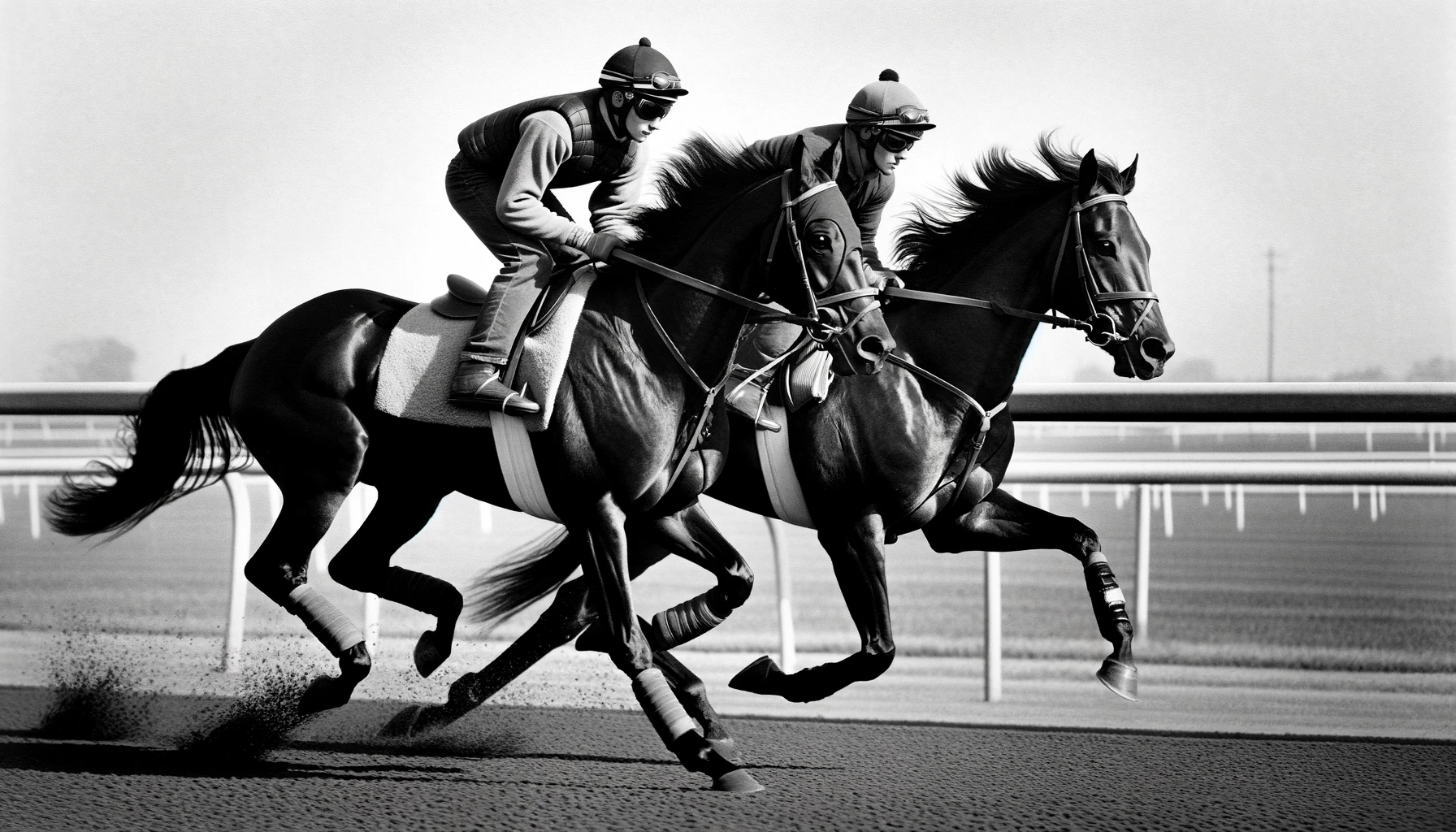
Secretariat had an impressive build that indicated even to amateurs that he had the shape a runner needs. Together with his excellent results on tracks and the establishment of records, he easily became the favorite of the masses. Everyone wanted to be a fan of the obvious winner, and the propaganda that followed each title was also of great help to his fame.
🏆 Secretariat’s Times
| Distance | Time |
|---|---|
| 6 furlongs | 1:09 4/5 |
| 1 mile | 1:33 2/5 |
| 1 1/16 | 1:42 4/5 |
| 1 1/8 | 1:45 2/5 |
| 1 3/16 | 1:53 2/5 |
| 1 ¼ | 1:59 flat |
| 1 3/8 | 2:12 1/5 |
| 1 1/2 | 2:24 flat |
| 1 5/8 | 2:37 4/5 |
Secretariat History and Victories: Triple Crown, Kentucky Derby, Preakness Stakes
Secretariat had a pedigree background, sired by the Hall of Fame racehorse Bold Ruler (1957’s Horse of the Year). His dam, Somethingroyal, was the daughter of Princequillo, that won many important races of longer distances.
It was 12:10 a.m. on March 30, 1970, when the red chestnut colt Secretariat was born. He stood after 45 minutes, still too soon to determine the bright future he would have. According to Chenery, however, he always had something special that distinguished him from the others. The name Secretariat was chosen on the second set of names submitted to a Jockey Club, suggested by Elizabeth Ham, the secretary that worked together with Chenery, with inspiration in her own job.
The colt grew into a massive horse of 66 inches (168 cm), impressively well-balanced, and large to the point of needing a customized girth. At first, Secretariat was a bit awkward when running and did not impress trainers. Everything changed on June 24, 1972, when he ran 6 furlongs in 1:12 4⁄5 on a sloppy track.
🥇 Horse of the Year in Two Years
The first races of Secretariat began with him lagging behind, only to close ground rapidly near to the end. His big move around the turn almost got him the first place in the Belmont’s Champagne Stakes, but an inquiry gave the victory to Stop the Music. Only 2 weeks later, at the Laurel Futurity, Secretariat overcame Stop the Music for eight lengths.
In the same year, he won the Eclipse Award for the American Champion Two-Year-Old Male Horse and defeated another two-year-old, La Prevoyante, to receive the American Horse of the Year. That honor was only given to a two-year-old again in 1997.
🥉 Year Three: Pivot or Disappointment?
To avoid selling Secretariat, Penny syndicated the horse in 32 shares of $190,000 each ($6.08 million in total), a record back then. It was only on March 17, 1973, in the Bay Shore Stakes, that Secretariat made his first apparition on tracks, already as a favorite, and had an easy victory. He also won by three lengths in the Gotham Stakes, matching the track record of 1:332⁄5.
On his preparation for Kentucky Derby, Secretariat somewhat disappointed his fans in the Wood Memorial, finishing third to Angle Light and Sham. The loss was attributed to an abscess in the horse’s mouth, making him sensible to the bit. However, the only consequence was some speculation on his chances next, as he did not repeat the disappointment.
🌟 Kentucky Derby: From Last to a Record-Breaking Star
In two weeks, the abscess healed, and Secretariat was ready for the Kentucky Derby. Breaking last out of the gate, he avoided a domino effect of bumping horses, and an increasing acceleration led it to battle with Sham until charging to win by 2 and a half lengths. His record of 1:59 2/5th stands to this day.
🏅 Preakness Stakes
Two weeks later, Secretariat once again broke last, this time in the Preakness Stakes. However, it did not last long, and he moved to first on the first turn. That movement, captured by the photographer Raymond Woolfe, was immortalized in John Skeaping’s statue of Secretariat.
This time, there was no horse that was up to the challenge, and Secretariat won by 2 and a half lengths, again with Sham finishing second. After almost 40 years of disputes about his finishing time, it was accepted as 1:53 flat, establishing a new record that remains unbroken.
Secretariat became a national sports celebrity, appearing in the magazines Time, Newsweek, and Sports Illustrated.
🏆 Secretariat Wins the Triple Crown
The date is June 9, 1973, Belmont Park, and it’s the final racing day of the Triple Crown. That race could and did determine the first winner of the Triple Crown in an incredible 25 years.
Different from the last two races mentioned here, Secretariat has burst from the gates with some little competition from Sham that did not last long. His jockey, Turcotte, recalled that he had never experienced such a fast pace in his life. His opponents stood no chance, and the Triple Crown had its first winner since 1948, with 31 lengths ahead of the second position.
🐎 The Last Years
Secretariat was admitted into the National Museum of Racing and Hall of Fame in 1974. He was then sent to Claiborne Farm in Kentucky, where he had 582 offspring, from which 41 were stakes winners – although not nearly as great as their sire.
How Did the Famous Horse Secretariat Die?
The powerful horse Secretariat had to be put down in October 1989 due to laminitis, an incurable and debilitating hoof condition. That necessary euthanasia to avoid immense suffering was followed by the necropsy that revealed his big heart. He remains an unbeatable name among the most famous horses in the world.
🏆 Statues and Honors
Secretariat was buried whole, an honor that is not common to racehorses. Other than that, his introduction to the National Museum of Racing and Hall of Fame after his Triple Crown victory clearly states his value. Other honors include:
- Creation of the Secretariat Stakes (1974).
- Bronze statue Secretariat in Full Stride (John Skeaping, 1974).
- Two statues at the Kentucky Horse Park (Jim Reno, 1992; and Edwin Bogucki, 2004).
- 17th among the 40 greatest sports figures of the past 40 years (Sports Illustrated, 1994).
- 35th among 100 greatest North American athletes of the 20th century (ESPN, 1999).
- 2nd in the List of the Top 100 United States Racehorses of the 20th Century. (The Blood-Horse's, 1999).
- 2nd of the best racehorses (ESPN Associated Press, Sports Illustrated).
- 33-cent postage stamp with his image in the U.S. Postal Service (1999).
- Greatest Sports Performances in "Who's No. 1?" (ESPN Classic's, 2005).
- Kentucky Athletic Hall of Fame, being the first animal to receive such an honor (2007).
- Canadian Horse Racing Hall of Fame (2013).
- Statue of Secretariat and Ron Turcotte crossing the finish line at Belmont Stakes (2015).
- Triple Crown victory rated #13 of 100 Greatest Moments in Sports History (Sports Illustrated, 2016).
- There are 263 roads named after Secretariat in the United States, more than any other athlete (e.g., Secretariat Drive).
- 2010's film Secretariat (IMDb: 7,2)
- Bronze Statue of Secretariat and Turcotte (Jocelyn Russell, 2019).
Top 10 Most Famous Racehorses of All Time: Including Secretariat
Secretariat was one of the top 10 most famous racehorses of all time, and each one of them deserves to be featured here.
Compare their main characteristics and get to know each one of them better. It is important to highlight that the earnings cannot be compared between extemporaneous horses.
1. Secretariat: The Record-Breaker
Among the famous horses, Secretariat, or simply “Big Red”, elevated his already established popularity after being the first horse to win the Triple Crown in 25 years. More incredible than that milestone was the fact that the second horse was 31 lengths away. He was American Horse of the Year in 1972 and 1973, with two and three years of age, respectively. He also broke the world record in both Belmont Stakes and Marlboro Cup, being the 13th horse to earn more than $1,000,000 in prize.
- Born: 1970
- Bred: United States
- Sex: Stallion/Colt
- Track Record: 21 (16-3-1)
- Total Earnings: $1,316,808
2. Man o’ War
Man o’ War won 20 of his 21 races and was not as friendly as Secretariat. His strong temperament did not affect his popularity among the masses, especially because he provided them entertainment in a period of war. Unfortunately, Man o’ War never received the chance to try the Triple Crown, but his son War Admiral did and won.
- Born: 1917
- Bred: United States
- Sex: Stallion/Colt
- Track Record: 21 (20-1-0)
- Total Earnings: $249,465
3. Seattle Slew
Seattle Slew was the only horse to win the U.S. Triple Crown unbeaten until the victory of Justify in 2018. In 1977, it was the American Horse of the Year, a bit older than Secretariat. Even after beating a severe illness, it almost broke Secretariat’s record in the Marlboro Cup. He stood behind in terms of time for only two-fifths of a second. His descendants were winners in the Kentucky Derby, but none of them compared to their sire.
- Born: 1974
- Bred: United States
- Sex: Stallion/Colt
- Track Record: 17 (14-2-0)
- Total Earnings: $1,208,726
4. Winx: Modern-Time Winer
Winx is a recordist with the most highest-level races in Group 1 that was admitted to the Australian Racing Hall of Fame during her training in 2017. She has the same sire as Zenyatta, our 7th place, and collects two more records. One of them is with her four consecutive wins in the Cox Plate, while the other stands for the biggest amount in prize money compared to any Southern Hemisphere horse.
- Born: 2011
- Bred: Australia
- Sex: Mare/Filly
- Track Record: 43 (37-3-0)
- Total Earnings: A$26,241,176
5. Kelso
Kelso’s impressive track record is due to the longevity that is impressive for an American racehorse. Along that long road, he has beat more horses from the Hall of Famer than any other thoroughbred from the 20th century. It did not compete in the Triple Crown race but received the nomination of American Champion Three-Year-Old even so. His curriculum includes five victories in the Jockey Club Gold Cup at Belmont Park, five times American Racehorse of the Year, and Champion Older Male Horse for 4 years.
- Born: 1957
- Bred: United States
- Sex: Gelding
- Track Record: 63 (39-12-2)
- Total Earnings: A$26,241,176
6. Makybe Diva
Makybe Diva was transported to Australia as a filly, where she established her own record of winning the Melbourne Cup three consecutive times. She also was the seventh horse to ever complete the Cox Plate and Melbourne Cup double, was named Champion Australian Stayer from 2004 to 2006, and Australian Racehorse of the Year two times (2005-06).
- Born: 1999
- Bred: England
- Sex: Mare/Filly
- Track Record: 36 (15-4-3)
- Total Earnings: A$14,526,685
7. Zenyatta
Considering her earnings above $7 million, Zenyatta was bought for a true bargain, only Considering her earnings above $7 million, Zenyatta was bought for a true bargain, only $60,000 at the time. A good portion of it, $2.7 million, was due to her success in the Breeder’s Cup Classic. She won 19 of her 20 starts, which consecrated her the greatest filly of all time by Sports Illustrated. She was awarded American Horse of the Year in 2010, American Champion Older Female Horse a total of three times, and almost retired undefeated, were it not for one short-head.
- Born: 2004
- Bred: United States
- Sex: Mare/Filly
- Track Record: 20 (19-1-0)
- Total Earnings: $7,304,580
8. Hurricane Fly
Trained in France, Hurricane Fly returned to Ireland to win 22 of 32 Grade 1 hurdle races over obstacles. For a while, that remained a world record. Another great achievement was getting the Champion Hurdle at the Cheltenham Festival after 38 years. He also holds the record with five consecutive wins in the Irish Champion Hurdle (2011-2015) and for the most wins in Punchestown’s Champion Hurdle (2010-2013).
- Born: 2004
- Bred: Ireland
- Sex: Gelding
- Track Record: 42 (26-5-4)
- Total Earnings: £1,894,422
9. Black Caviar
The sprinter Black Caviar had an unbeaten career racing for four years, more precisely from 2009 to 2013. She was awarded the titles of Australian Champion Sprinter and Racehorse of the Year from 2011 to 2013, three consecutive years. In the meantime, she received the honor of being named European Champion Sprinter with only one race in the Northern Hemisphere in 2012. The Lightning Stakes, which is a Grade 1 race she won three times, was renamed Black Caviar Lightning in her honor.
- Born: 2006
- Bred: Australia
- Sex: Filly/Mare
- Track Record: 42 (26-5-4)
- Total Earnings: £1,894,422
10. Kincsem
After almost 150 years, Kincsem is still reminded as one of the most famous horses in Europe. It had an undefeated career with 54 victories in only four seasons from 1876 to 1879. She won the Grosser Preis von Baden three times, a record that only one more horse accomplished ever since. She conquered the sweetest spot of her career in 1878 when she won the Preis von Baden race, plus the Goodwood Cup and the Grand Prix de Deauville in a sequence. It is no surprise that she would later become a broodmare, with several famous descendants that conquered important titles.
- Born: 1874
- Bred: Hungary
- Sex: Filly/Mare
- Track Record: 54 (54-0-0)
- Total Earnings: 379,805 German Goldmark
FAQs: Secretariat
Secretariat had a total of 16 victories in his racing career.
It broke the track record of Kentucky Derby, Gotham Stakes, and Preakness Stakes. Also, Secretariat conquered the world record in Belmont Stakes and Marlboro Cup. He is also remembered for establishing a new course record in Man O’War Stakes.
Winning Brew is recognized as the fastest horse ever, but Secretariat collected several records at multiple distances.
The anatomy of the famous horse Secretariat assisted him in getting an incredible acceleration through power. Although not confirmed, his exceptional heart might have something to do with his excellent stamina.












 ️
️